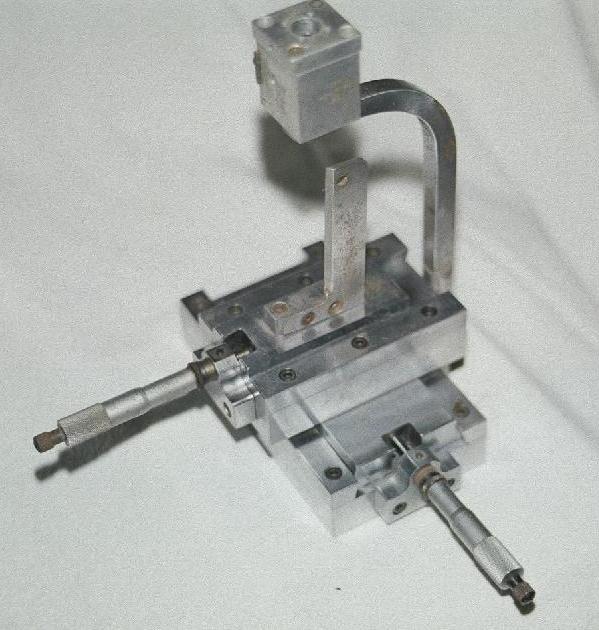
If you decide you do not have the means to make your own one can be purchased for $899
This website describes a unique Foucault tester that is very precise
and doesn't rely on rubberbands or ball bearings or other
materials that yield to inaccuracy in a knife edge tester. It is machined out of
stainless steel and uses two 0.001" micrometers. It also can be used as a ronchi tester and has the option of
using both 0.0001" on the first (knife edge) stage and the second,
which allows it to be used as a caustic tester.
The return mechanism of the foucault tester is a secret and I have never seen it on any
other knife edge tester.
Measuring any optical surface requires highly accurate mirror testing
instruments and this machined tester yields great results.
As an amateur telescope maker I have been the route of fabricating foucault
testers out of wood and makeshift measuring rods but this machined unit gives high precision. When looking for a knife edge tester for a mirror
tester this works great! This is a machined foucault tester with one axis exactly 90 degrees to the other.
If you decide to construct this tester let me know how you make out.
An explanation of the construction of the tester itself.
The tester is built out of stainless steel which gives it considerable weight so it won't move when on a table top and will not
rust. It
probably could of been made out of aluminum and had a threaded rod and wide wing nut attaching to it's base from the underside
that could of kept it in place through
a hole in your tester stand. It is actually simple in design which gives it it's beauty. Essentially one stage is fixed
on another stage. Each stage is comprised of an upper and lower unit. As the pictures show the upper unit of both stages
are dove tailed with dovetailed rails on either side holding it in place. There is just enough space with a little clear
grease
to keep it travelling with no play on either side. A pin is placed near one end of it. In the lower base of each unit is a
routered slot which sits a pin near the opposite end that holds a spring that enables the stage to be returned. Both pins are further apart than
the actual length of the spring which gives it the resistance. No ball bearings to fall off or
elastics to break! The use of the spring is simplicity itself. The unit can be scaled to any dimensions. The one shown is
4" X 8" on the lower stage and 3" X 6" on the upper stage. The thickness of the lower units are 1.25" and the rails are 0.50".
On this teser the slit is directly above the knife edge. There is a separate micrometer bracketed
to each stage. The lower unit of the upper stage is
is bolted to the upper unit of the lower stage at 90 degrees. As the picture shows, the rails are held in place with counter
sunk allen hex bolts. If you are a metal worker the tester should be easy to build and if not could be made by a machinist. I've tried
various types of testers in as an amateur telescope maker and have found this one to be the best. Good luck with your mirror
making and lets get highly accurate mirrors made for viewing!
Click on the pictures for larger versions.
The foucault tester from the rear, notice both micrometers on each axis.
The micrometer making contact into the lower stage of the tester.
The dovetail of the lower base. Gives you an idea of the rails that are on both sides.
The dovetail on the upper stage.
The upper stage and right rail by itself. You can see how the rail matches the complimentary angle of the upper stage.
The rail is fastened on either side of the upper base with counter sunk allen bolts.
The rail by itself. The right hand side is milled 90 degrees flat and the inside has been dovetailed. It is held in place
by 3 allen bolts. It holds the stage in place as it slides back and forth.
The upper stage holding the knife edge with the left rail removed. The right hand rail is in place.
The centre stage taken off and shows the pin protruding from it's lower side. The knife edge is to the left.
Same as # 9.
Shows the upper stage and rails totally removed and exposes the routered slot in the upper base which holds
the other pin, in the upper left that the spring is attached too.
Same as # 9.
Same as # 9 but the spring has been removed and shows the pin that the spring is attached to.
The spring that is used for the return mechanism. Note that the loop of the spring is lower on the left side and higher
on the right side to be held by the pins of the upper and lower stages.
The micrometer bracket that holds it in place and mounts to the side of the tester.
Shows the allen bolts that hold the rails of the tester in place. They are counter sunk.
The slit and the knife edge. Notice that the slit is above the knife edge.
Me!
My best friend. Her name is Casey and she is a lovely Husky\Keeshond mix.
A '64 280 SE Mercedes Benz convertible. One of my favourite cars.
Keywords: foucault tester knife edge tester knife-edge tester ronchi tester caustic tester ronchi caustic mirror making
telescope catadioptric newtonian gregory schmidt cassegrain parabola sphere testing apparatus dial indicator micrometer
slit radius of curvature focal length autocollimation polishing mirror maker pitch lap cerium oxide amateur telescope maker
zones test mask grinding grit micron powder wet grinding stand tool plate glass pyrex astro sitall astrositall sagitta abrasives
silicon carbide pitch squares optics testing equipment pinhole testing and correcting turned edge oblate spheroid ellipsoid
paraboloid hyperboloid figuring waves mirror correction making pitch squares shadows lens lense secondary primary effective
focal length shadow appearance inside focus outside focus zonal measurements light beam light source dog biscuit spider web
stroke length grinding stand concave convex mirror blanks turned down edge turned up edge shadow test spherical aberration
wavelength of light collimation baffle tubes maksutov gregorian meniscus reflecting refracting light rays coma astigmatism
curvature of field distortion mirror blanks mirror making kits razor blade upper curve lower curve paraboloidal curve centre
zone image shadow patterns cone of light correction curve measured curve hyperbolic edge eliptical edge ellipsoid oblate edge
central hill aspherized radius testing spherometer