

“Dan
Learning Bridge website - Bridge Lessons Review,
Part 1: The eBooks (http://learningbridgespot.com/)
Bridge – The Beginner’s Guide
by Dan Berkley
Copyright © 2012 Dan Berkley
All rights reserved
Reproduction of any portions of this
book by any means whatsoever is a violation of the copyright protection and it
is illegal, except by special arrangement with the author.
ISBN: 978-0-9880908-0-4 (pdf)
Images and photographs by Dan
Berkley or in public domain, unless otherwise specified.
Cover by Dan Berkley and Matt Dean
Dan Berkley
Mississauga,
Ontario, Canada
BRIDGE
The Beginner’s Guide
Table of Contents
Introduction
Lesson 1 – The Game of Bridge
1.1 Basic terms
1.2 The bridge table
1.3 Shuffling and dealing
1.4 Bidding
Lesson 2 – The Game of Bridge (cont’d)
2.1 Playing the hand
2.2 Scoring
Lesson 3 – The Bidding
3.1 The bidding
3.2 Hand evaluation
3.3 Opening bids at the one-level
Lesson 4 - The Bidding (cont’d)
4.1 Opening bids at the two-level
Lesson 5 – The Bidding (cont’d)
5.1
Responding bids to openings at the one-level
Lesson 6 – The Bidding (cont’d)
6.1 Responding bids to openings at the two-level
Lesson 7 – The Bidding (cont’d)
7.1 Rebids
7.2 Opener’s rebids after opening at 1-level in a suit
Lesson 8 – The Bidding (cont’d)
8.1 Rebids (cont’d)
8.2 Bidding after overcalls
Lesson 9 – The Bidding (cont’d)
9.1 Overcalls and responses to overcalls
Lesson 10 – The Bidding (cont’d)
10.1 Slam bidding
10.2 Preemptive bidding
Lesson 11 – The Hand Playing
11.1 General description
11.2 Hand playing in offense
Lesson 12 – The Hand Playing (cont’d)
12.1 Hand playing in offense (cont’d)
12.2 Techniques in offense play
Lesson 13 – The Hand Playing (cont’d)
13.1 Hand playing in defense
13.2 Signals in defense play
13.3 Techniques in defense play
Lesson 14 – Laws, Ethics and Etiquette
14.1 General description
14.2 Laws
14.3 Ethics and etiquette
Conclusion
Appendices
Appendix 1: Glossary
Appendix 2: Answers to exercises
Appendix 3: Scoring tables
Appendix 4: Players movement for two-table revolving
duplicate
LESSON 3 - The Bidding
3.1. General Description
In bridge, the bidding (often called the auction)
is actually an exchange of information between the two partners to establish
the highest contract the pair can make, if a game is sure, possible or out of
the question, and what suit is best to be the trump suit, if any. Then, the
players bid accordingly.
As the opposite pair at that table is doing the same thing,
the two pairs are bidding for the
contract to play, evaluating their hands continuously to know where to stop.
The bidding is done by just naming how many tricks you think
your pair can make over the book and
the suit you would like to be the trump suit (or no trump). As mentioned, the
bid also conveys information about the strength and distribution of your hand
to help your partner evaluate the partnership overall strength.
For example: “One spade” means you think your pair can take
6 (the book) + 1 = 7 tricks, with spade being the trump suit, and that you have
a hand of a certain strength and distribution (details are presented in
following sections).
It is illegal to use more than the exact bidding language,
or tone intonation, or any kind of body language or body signs. For example, do
not say “I pass” or “I bid one heart”. Just use the proper bidding language (“Pass”,
and respectively “One Heart”, in our example). In competitions, you are
penalized according to the Laws of Duplicate Bridge if you do
this.
Bridge clubs and tournaments use bidding boxes instead of
voice bidding to prevent any illegal voice signals. In addition, full table
screens are used in big competitions (refer to Lesson 14).
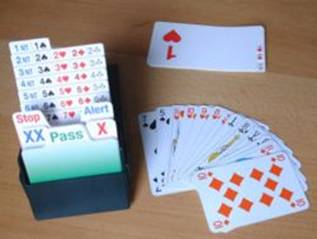
Figure 3.1. Bridge bidding box.
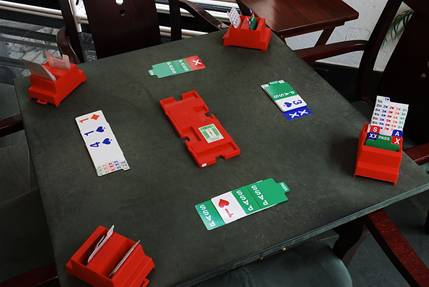
Figure 3.2. Bridge bidding boxes
and cards board in duplicate bridge.
Notice how the bidding
cards are used.
The bidding system and the conventions you are playing with
your partner must be made known to the opposite team sitting at your table.
Consequently, in competitions, standard convention cards are filled in and
made available to the other pair.
If you use conventions that are not in the system you must alert
your opponents (just say “Alert!” before you bid, or show the “Alert” card if
bidding boxes are used). The opponents may ask you to explain what the bid
means.
The bidding guidelines presented in the following sections
are based on the principles of the modern "Standard American" bidding
system, "5-card major" style. These guidelines are not rules that
must be obeyed according to the Bridge Laws. However, if you do not follow the
guidelines properly, you convey false information to your partner and your pair
gets into a wrong contract. The guidelines will address the following aspects
of bidding:
·
hand
evaluation
·
opening
bids at the one-level
·
opening
bids at the two-level
·
responding
bids to openings at the one-level
·
responding
bids to openings at the two-level
·
rebids
·
overcalls
·
slam
bidding
·
preemptive
bidding
·
conventions
3.2 Hand Evaluation
The strength of a hand determines its potentials to win
tricks when the play starts. It depends on two factors:
·
high-card
points (HCp, points assigned to the honor cards)
·
distribution
points (Dp, points that depend on suits length. They are valuable for suit
contracts.)
Points are assigned to the high cards and to the cards
distribution in each suit to help evaluate the strength of the hand, as
follows:
| HIGH-CARD POINTS | DISTRIBUTION POINTS | ||
|---|---|---|---|
| Ace | = 4 | Void (no cards in a suit) | = 3 |
| King | = 3 | Singleton (1 card in a suit) | = 2 |
| Queen | = 2 | Doubleton (2 cards in a suit) | = 1 |
| Jack | = 1 | Any card over 5 in a suit | = 1 |
Notes:
- there are 40 HCp in the deck;
- HCp for singleton honor cards are
not counted, except for the Ace
- count only the high card points (HCp) when
bidding notrump contracts
- where ever in these lessons the high card
points (HCp) are not specifically
mentioned, the respective points refer to total points (high card plus
distribution).
The strength of the hand increases if:
·
you
have one or two long suits (+ 5 cards) rather than two or three 4-card suits
·
you
have high spot cards (tens and nines) in your long suit(s). They often
win additional tricks in that suit.
·
you
have extra trumps. Add 1 Dp for each extra card in addition to the 8-card fit .in
the combined hands or, if you have more than 5 cards in the suit you want to
bid.
The value of a hand is given by the total of high card and
distribution points. Experience shows that to make a game (minimum 100 contract
points when you score), the two partners should have the following minimum
total number of points in the combined two hands:
| 3 NT | = 25 - 26 HCp |
| 4 in a major suit | = 25 - 26 p |
| 5 in a minor suit | = 28 - 29 p |
| small slam | = 33 - 34 p and minimum 3 Aces |
| grand slam | = 36 - 37 p and all 4 Aces |
When bidding notrump contracts, count only the high card
points (HCP).
The shape of the hand, high spot cards and other
considerations may modify slightly the range of the points the pair should have
for a certain contract. For example, you may need 1 less point for slam or for
game contracts if you have a few 10s and 9s.
Attention: There are all kind of points in bridge, be careful
not to confuse them:
·
scoring
points:
o contract points
o bonus points
o penalty points
·
points
used to evaluate the strength of your hand
o high-card points
o distribution points
o total points (high-card plus
distribution
Another important factor in hand evaluation is the shape of
the hand: balanced or unbalanced.
A balanced hand has no voids, no singletons and maximum one
doubleton. Thus, it can have the
following patterns:
x x x x x x
x x x x x x x
x x x x x x x x x x
x x x x x x x x x
x x x x x x x
4-3-3-3 4-4-3-2 5-3-3-2
All the other hands are unbalanced.
Typically, an unbalance hand is more suitable to play a
trump contract. A balanced hand is good for a notrump contract, although a long
suit can bring many tricks.
In case of a trump contract, the team playing it should have
the control of the trump suit.
Experience shows that the combined hands of the partnership playing a
trump contract should have a fit of at least 8 cards in the trump
suit (typical patterns: 5 - 3, 4 – 4, 6
– 2).
The hand strength should be continuously re-evaluated as the
bidding progresses, depending on both the bidding of your partner and of your
opponents.
For example, the value of KJx in a suit should be dropped
from 4 HCp to 1 – 2 HCp if the respective suit was bid by your LHO (after you)
because he probably has higher honors to take yours.
Another example: assuming you are declarer of a suit
contract and the trump suit is long in your hand, any shortness in a suit of
your hand does not count for too much. Your shortness will not bring any
additional tricks “per se” by ruffing in it from the length of the trump suit,
as your trumps are good anyhow. Thus, you would double-count the tricks they
could take.
For the purposes of these lessons, we are not going to get
into the details of hand re-evaluation. Just keep in mind the above comments
when the occasion comes up and read more to master it.
3.3. Opening Bids at the One-Level
The dealer seats in the 1st seat for that hand
and he is the one to make the first call. It can be a positive bid, or it can be “pass”
if his hand is weak.
The 1st
player making a positive bid (not passing) is said to be the opener (he opens the
bidding for that hand and also for his partnership). The following player (his
LHO) will be in intervention. If he
makes a positive bid, it is called
an overcall.
The players who
respond to the opener and respectively to the overcall are said to be responders.
For the purposes of keeping these lessons simple, we will treat
for now the overcall bidding as the opening bid for his pair, even if this is
not correct and his bidding may actually be different (we’ll see this later
on).
Once you have done your initial evaluation of your hand, you
are ready to bid. To open the bidding for your team
(ignoring for now the fact that you may actually overcall), your hand should
meet certain criteria.
For Opening in a Suit at the One-Level (1♣, 1♦, 1♥, 1♠) you need:
·
13-21 p (total points, high
cards plus distribution)
·
biddable suit(s):
a) with
one or more long suits (minimum 5 cards)
o
open in the longest suit, or
o
open in the higher ranking suit if you have a 5-5 or 6-6 pattern
b)
with no long suit (less than 5 cards)
o
open in the longest minor, even if you have a 4-card major
o
open with 1♦ if you have 4♦ and 4♣
o
open with 1♣ if you have 3♦ and 3♣, to keep the bidding
level low
A biddable suit is a 4- or 5-card suit
with minimum 4 HCp in it (e.g.: Axxx, or KJxxx, etc.). In case of a strong
hand, QJxxx (3 HCp) is also biddable.
The Standard American
5-card major style requires that you have minimum 5 cards in the major you
want to bid. (refer to item a, above). Otherwise, you open 1-in-a-minor (item b)
and bid the 4-card major (which should be biddable) in the second round of
bidding.
The well-known player and writer Marty Bergen introduced a
useful guideline for opening in the 1st or 2nd seat, the
so-called RULE of 20:
Open the bidding for your pair if the total number of cards in the
two longest suits plus the number of HCp is equal to or grater
than 20.
Competitively, the player in the 3rd seat may
open with less than 13 p, or with a more relaxed Rule of 20, if the players in
the 1st (the dealer) and 2nd seats passed. How much
relaxed, depends on the vulnerability:
·
if vulnerable: minimum 11 p and a solid 5-card suit
·
if not vulnerable: minimum
9 p and a solid 5-card suit
Now, you will ask how will the
partner know if you opened with normal strength (+ 13 p) or weaker? There are
conventions that can be used, (e.g.: Drury), however this is beyond the scope
of these lessons. For now, it may be better to open with +13p in 3rd
seat, too, even if the 1st and 2nd seats passed.
For Opening with 1NT you need:
·
15 - 17 HCp exactly
·
balanced hand (no voids and
no singletons)
·
preferably stoppers
in all the suits
A stopper is a sure trick, such as Ax, KQ, QJ10, J1098. Sometimes, in a competitive game and with maximum
of points (17 HCp) you can open 1NT even if the highest card in a suit is not
fully defended, such as QJx, or J10xx.
The modern Standard American bidding system makes it more
important to show your strength in high card points (15 – 17 HCp) than to show
a balanced hand or that you have stoppers on all the suits. This is something
to be agreed upon by the respective pair. However, I advise that at the
beginning, while you still learn the game, you should open in notrump with
balanced hands (maximum one doubleton) and stoppers on all the suits.
With a 5–card major and 15 – 17 HCp, there is a continue
debate if the opening should be in notrump or in the major. I suggest you open
in that major. It is easier to make a game in 4-in-a-major (if you have a good
fit) than in 3NT, even if it is one level up. In addition, a game in a major
brings more score points than a game in 3NT.
With 5 cards in a minor, no voids and maximum a doubleton it
is preferably to open 1NT, particularly if you have stoppers on all the suits.
After you gained experience, you may start opening in NT
with stoppers on only three of the suits, the idea being that your partner
may have stoppers in the suit you are missing.
If the hand has a doubleton, it should be Ax or KQ.
Otherwise, open 1 in a suit, at least as a novice.
With 18 – 21 HCp and a balanced hand, you open 1 in a suit
and show the strength in the second round of bidding. More details about strong
hands are in following lessons.
Thus, we learned in this lesson about:
·
the
mechanics of bidding
·
hand
evaluation
·
opening
at 1 – level in a suit
·
opening
at 1 – level in notrump
Did you
know that the most common bridge hand pattern is
4-4-3-2
(about 21.5% of the time)?!
Quiz
1) How many high-card and total points are in each of these
hands? What do you open?
♠ A x x |
A Q x x x x |
K x |
A Q J x x |
||||||||||||||||||||||||||||||||||||||||||||||||||
♥ A K J x |
x |
A x x x x x |
K J 10 x x |
||||||||||||||||||||||||||||||||||||||||||||||||||
| ♦ Q J | A x | K Q x x x | x | ||||||||||||||||||||||||||||||||||||||||||||||||||
| ♣ x x x | J x x x | -- | Q x | ||||||||||||||||||||||||||||||||||||||||||||||||||
| Ex. 3-1 | Ex. 3-2 | Ex. 3-3 | Ex. 3-4 | ||||||||||||||||||||||||||||||||||||||||||||||||||
|---|---|---|---|---|---|---|---|---|---|---|---|---|---|---|---|---|---|---|---|---|---|---|---|---|---|---|---|---|---|---|---|---|---|---|---|---|---|---|---|---|---|---|---|---|---|---|---|---|---|---|---|---|---|
♠ A Q J x |
A Q J x |
K Q x |
K x x |
||||||||||||||||||||||||||||||||||||||||||||||||||
♥ K Q J x x |
K Q J x |
K x x |
x x |
||||||||||||||||||||||||||||||||||||||||||||||||||
| ♦ x | x x | A x x x | K J x x | ||||||||||||||||||||||||||||||||||||||||||||||||||
| ♣ Q x x | Q x x | K Q x | A K x x | ||||||||||||||||||||||||||||||||||||||||||||||||||
| Ex. 3-5 | Ex. 3-6 | Ex. 3-7 | Ex. 3-8 | ||||||||||||||||||||||||||||||||||||||||||||||||||
♠ K Q x x |
K x |
K Q x |
K |
||||||||||||||||||||||||||||||||||||||||||||||||||
♥ x x x |
A Q x x x |
A Q x x |
A Q x x x |
||||||||||||||||||||||||||||||||||||||||||||||||||
| ♦ A K x | K Q x | K Q x | Q J x | ||||||||||||||||||||||||||||||||||||||||||||||||||
| ♣ Q J x | Q J 10 | Q J 10 | x x x x | ||||||||||||||||||||||||||||||||||||||||||||||||||
| Ex. 3-9 | Ex. 3-10 | Ex. 3-11 | Ex. 3-12 |
2) How many points do you think that you need in the combined
two hands to make the following contracts:
a.
2
in a suit
b.
3
in a suit
c.
2
in notrump
This is a
very important question, as you will play a lot of contracts below the game
level.
Note: The answers are in the Appendix 2.
E-mail Dan Berkley for paying by check or to order "live", online lessons

